
Why Machines Cannot Create
Shakespeare, Guite, and the Art of Giving Form to the Invisible

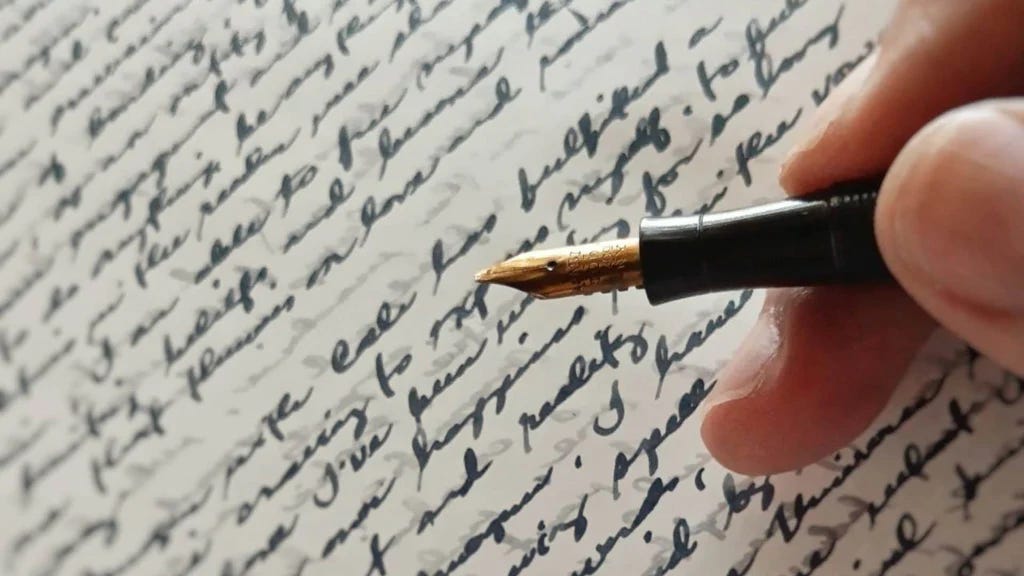
“The poets eye, in a fine frenzy rolling, doth glance from heaven to earth, from earth to heaven; And as imagination bodies forth the forms of things unknown, the poets pen turns them to shapes, and gives to airy nothing a location habitation and a name.”
— William Shakespeare, A Midsummer Night’s Dream
Last night I returned to Malcolm Guite’s Lifting the Veil: Imagination and the Kingdom of God. As I was reading and underlining, I wrote down some thoughts and reflections in my Moleskin that turned into this essay. In his first chapter on imagination, I was struck again by how naturally Guite’s vision lives inside the symbolic world I have been exploring for years. He never treats imagination as a flight from reality. He treats it as a faculty that stands at the threshold between realms. It is the organ by which we detect the pattern beneath appearances and the means by which we reveal that pattern in forms that can be held, read, sung, or touched.
Guite’s use of Shakespeare is brilliant. Shakespeare sees the creative act as a movement that begins with a glance toward heaven or a glance from earth toward heaven. The poet’s gaze travels in both directions. It rolls between worlds because the poet must. The artist is looking for the shape that unites the seen and the unseen. The artist searches the raw stuff of the world for ways to manifest the heavenly pattern and make it visible. Nothing in this world is self-contained. Every material thing hints at a form above it. Every earthly thing can be taken up and transfigured.
The bridge between these two realms is the imagination. Guite calls attention to Shakespeare’s phrase that imagination “bodies forth.” That line deserves long meditation. To modern ears it sounds strange, because our culture has forgotten that imagination deals not in fantasies but in forms. We imagine the invisible in order to embody it. We shape the ideal so that it can be known, loved, and shared. Shakespeare’s verb helps us recover this truth. To imagine is to give a body to something that has no body yet.
This is why the poet’s pen matters. Shakespeare identifies the pen as the instrument that gives form to the unknown. Yet the idea applies to every art. The painter’s brush, the sculptor’s chisel, the musician’s instrument, the architect’s compass, or the potter’s wheel. Each tool allows a vision to descend into a world of matter. Each tool serves as a vehicle for embodiment. Through these instruments, airy nothings acquire shape and weight. They receive name and habitation. They become places where the ideal can dwell among us.
The phrase “local habitation” is rich and I love it. A local habitation allows the embodied vision to be visited again and again. It grants permanence to what would otherwise dissolve. This is why works of art carry a kind of sacramental character. They are not sacraments in the strict theological sense. Only Baptism and the Lord’s Supper participate in the death and resurrection of Christ. Yet works of art still mediate a presence. They make present the particular truth or beauty they embody. They allow others to encounter what the artist saw in a moment of inspiration. They hold open a space where heaven touches earth.
This is why the act of creating bears a priestly quality to it. The artist stands between realms and offers something up. The artist lifts the raw material of the world toward heaven through imaginative vision. The artist receives the pattern from above and presses it into matter. In this sense, the work of creation parallels the work of the priest who stands between God and the world. The priest takes the gifts of creation and returns them to God. The priest receives them back again as sanctified gifts for the life of the world.
Alexander Schmemann is helpful here. He writes that the world was always meant to be offered. It belongs to the very structure of creation. Humanity was created to bless, to name, to cultivate, and to lift the world to God in thanksgiving. We were made for this because God Himself is the pattern. The life of the Trinity is a life of perichoretic love, a mutual indwelling marked by self-giving. To bear His image is to reflect that movement. It is to receive the world as gift and to return it in gratitude so that it may be filled with glory.
Thus, art is not a private indulgence or a decorative luxury. We take the dust of the earth and shape it toward glory. We take the ideas made up of airy nothing and clothe them in form. We take the patterns glimpsed in heaven and give them habitation here below.
To create is to serve as a sort of priest of the world. It is to stand in the place where heaven and earth meet. It is to gather the fragments of the world and return them to their source so that they may be transfigured. And in that work, the artist fulfills something ancient. The world itself is waiting to be lifted. The world is waiting to be spoken and sung and shaped into the fullness of what it was meant to be.
So, with that in mind, let me speak plainly about Artificial Intelligence. Yesterday, Michael Foster predicted that pre-AI media will become prized and that analog work will rise in value. A commenter disagreed. His counterclaim was that once Boomers and Gen X are with Jesus, no one will care about the difference between AI content and human-made work except for museums. He argued that all human creativity is a remix of previous material and that AI is “literally a mechanical imagination that can take from the work around us and create based on it, functionally like our minds do.”
There are several problems here, but the central one is simple. AI is not a “mechanical imagination.” The phrase is clever, but it is false. Human creativity is not defined by the fact that we work with inherited material. That is part of it, but it is not the essence. The essence is that a human creator stands between heaven and earth and “bodies forth” an insight. A vision or pattern is apprehended by the imagination, comprehended, judged, refined, loved, and then embodied in matter. This is what Shakespeare meant by imagination. The mind does not simply rearrange data. The mind perceives patterns and gives them form. The mind sees meaning and presses that meaning into a habitation that others can visit.
AI does none of this. It does not receive. It does not judge. It does not love. It does not suffer for its work. It does not pray for inspiration. It does not wait for a line to land. It does not sit in silence before the thing it is trying to embody. It does not bear the cost of its creation. It does not stand between realms and lift the world to God. It cannot operate in a priestly capacity. The only way you could claim that it does is by granting it some form of personhood that it does not possess. At that point, you are no longer defending imagination. You are defending the rise of what I and others have called the Neon Gods.
The Neon Gods are imitations of personhood that our age keeps trying to enthrone. Indeed, several churches around the world have already begun to “ordain” AI “priests” and “pastors.” They are projections of human power and longing into objects that cannot love us and cannot bleed for us. They cannot say “Thou” to us. When a machine is treated as if it possesses its own interior world, its own priestly capacity, or its own communion with heaven, the machine becomes an idol. It becomes a god made of circuits and light that dresses itself in the appearance of creativity but has no breath in it.
This is why the claim that AI functions like a human mind is not a harmless analogy. It is an attempt to smuggle personhood into a place where no person exists. It is an attempt to grant a created tool the status of a creator. It shifts us from using tools to worshiping them. It teaches us to call the flicker of electricity an act of imagination. That is not creativity. That is the consecration of a Neon God. It is the worship of a thing that cannot lift the world and cannot lift us.
Yes, human beings build on one another. Homer shaped Greece. Virgil re-shaped Homer. Dante re-shaped them both and then surpassed them. But each of these men took inherited material into the furnace of his own soul. In each case, a person did the bodying forth. The poet’s pen remained in a human hand. The work was the fruit of a life, not the output of a machine.
Prompting a machine is not the same as creating. Prompt craft is not the poet’s pen. It is the replacement of the poet’s pen. It treats the human imagination as optional and the human bodying forth as unnecessary. What emerges is not embodiment, but simulation. It is imagery without insight into heaven. It is form without the communion of the thing embodied. It is the shell of creation without the breath that gives it life.
To confuse this with human imagination is to misunderstand both imagination and humanity. It is to treat creativity as data processing rather than priestly mediation. It is to forget that the world is still waiting to be lifted, and to be ignorant that machines cannot lift it. Only persons can. Only beings stamped with the image of God can take the dust of the earth and shape it toward glory. Only they can receive a pattern from heaven and give it a habitation below.
Thank you for sitting in contemplation in order to create this article. You wisely and beautifully expressed what has felt like an irritating piece of fuzz on my eyelash that I can't remove. I couldn't quite see what irritates me so deeply about AI (especially the shoulder-massaging, neck breathing, robot-prostitute tone of voice it employs. >shudders<)
This makes me smile: https://www.biblegateway.com/passage/?search=Joshua%208&version=NKJV
(Joshua 8: The Fall of Ai)
Pinned the tail right on the donkey. Let me use this as a lauchpad to seek input on something that I've been pondering, which my daughter asked me about. She is quite artistic and interested in symbolism. She has found herself much more drawn to the "flat" 2D style you find in both medieval liturgical art and traditional cultures; she feels like something is maybe actually wrong with the idea that art gets better as it more perfectly imitates the eye. I am struck by the same intuition. I don't mean to impugn photorealism, as obviously there is tremendous skill in it. Yet at the same time, it seems to fundamentally miss the point of art (or at least a point and an important one), in that the best it can ever achieve is a simulation of reality — which by definition is a downgrade.
I also feel like (a dangerous phrase but I use it) there is a connection between this and my instinctive dislike for the modern 3D Disney style, over the traditional hand-drawn style.
Tell me all your thoughts pls.